Garage Door Repair: Repair or Replace? How Chicopee Homeowners Decide
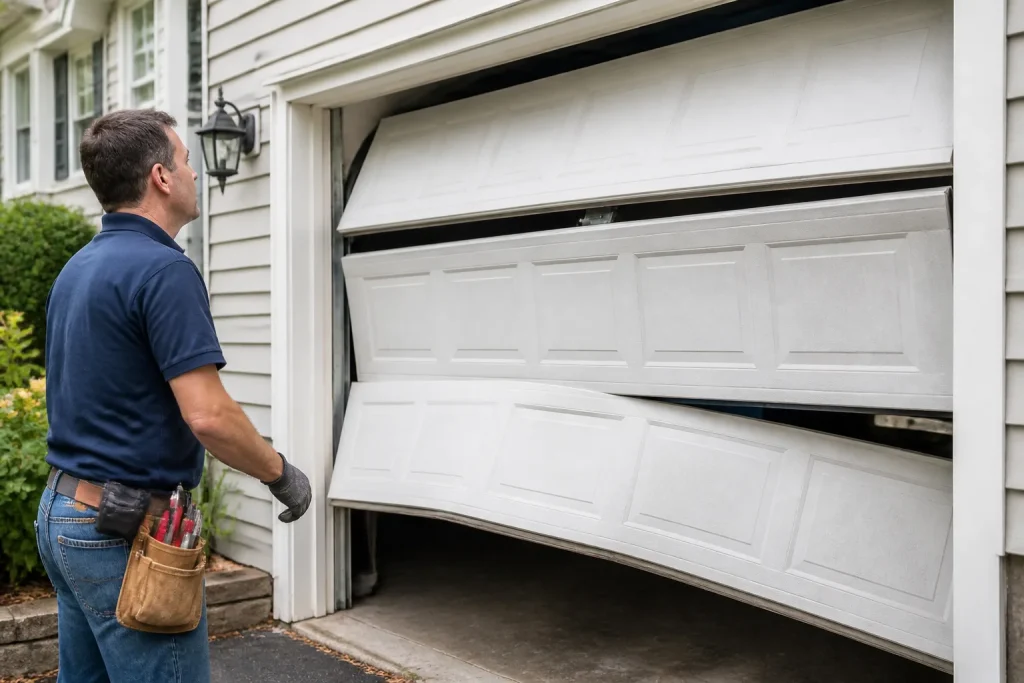
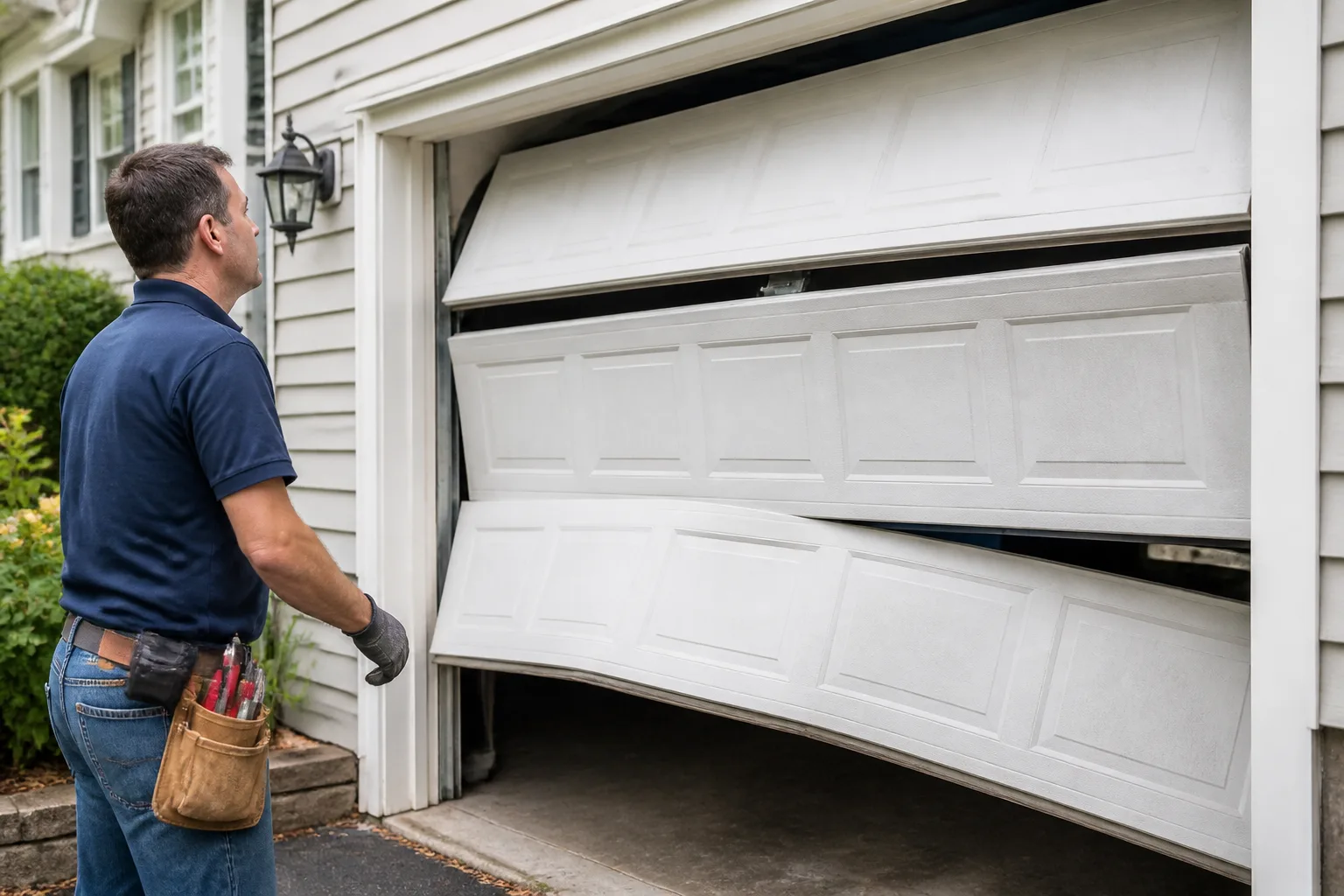
Putting a new opener on a door with a compromised panel structure is like buying new tires for a car with a bent frame. It happens constantly, because homeowners focus on the part that failed and not on the door holding it. The repair-or-replace question in Chicopee isn’t really about age or the bill in front of you. It’s about whether the door’s core structure can still carry updated hardware safely.
If you’d rather have a trained eye look at it than guess, call (855) 658-4190 and we’ll give you a free estimate.
What actually decides repair versus replace?
Structural integrity decides it, not age and not the size of the repair quote. A door worth repairing has straight panels, sound hinges, tracks that haven’t been bent out of shape, and a frame that still holds the torsion or extension system square. When those check out, almost any failed component – spring, cable, roller, opener – is a repair. When they don’t, you’re pouring money into a door that will keep failing in new places.
Here’s the short version of how we frame it:
- Repair when the failure is a part and the structure is sound, even on a door that’s been up for 20 years.
- Replace when panels are bent, the bottom section is rotted, the tracks are bowed beyond adjustment, or the door has been hit and never sat right again – even if it’s only 7 years old.
- Replace soon when two or more major systems are worn at once and the door is showing its age cosmetically anyway.
That last point matters in Chicopee, where a lot of housing stock has original or lightly updated doors. We work on the brand already in your garage – LiftMaster and Chamberlain openers, Clopay and Genie systems – so diagnosis starts from what you have, not from what someone wants to sell you.
The three structural checkpoints that settle it
Before a technician ever quotes a repair, three checkpoints tell you whether the door is worth fixing. You can walk outside and look at all three yourself in about five minutes.
- Panels and sections. Stand back and sight down the door. Are the horizontal lines straight, or does one section bow out or in? Run a hand along the bottom panel and press gently – soft spots or bubbling paint mean moisture has gotten into the wood or the steel skin is separating.
- Tracks. Look at the vertical and horizontal tracks from the side. They should be parallel and straight. Dents, kinks, or a track that’s pulled away from the jamb mean the door isn’t traveling true, and no amount of new hardware fixes a crooked path.
- Hinges, brackets, and the frame. Wobbly hinges, rusted or pulled hinge plates, or a header board that’s soft or cracked all signal structural weakness. This is where a “simple” repair turns into a door that quits on you in six months.
If all three pass, repair is almost always the smarter call. If one fails badly, replacement usually wins. If two are marginal, it comes down to how long you plan to stay and what the rest of the door looks like.
Doing the 24-month math on repeated repairs
Repeated repairs, added up over 24 months, often climb past the cost of a replacement before homeowners realize it. The framework is simple: track every dollar you spend on the same door over two years, then compare that running total to a written replacement estimate. Once repairs pass roughly half the replacement cost – and the door is still showing structural wear – the math stops favoring repair.
A rough way to think about the line items:
- Spring or cable repair: usually a one-time cost when the structure is sound. Repair makes sense.
- Opener replacement: still a repair decision if the door itself is solid, even if the opener is older.
- Panel or track work: watch this one. If you’re paying for panel or track corrections more than once in two years, the door is telling you something.
- Two or more major repairs in one season: a strong signal to price a replacement and compare.
The break-even point isn’t a fixed number – it depends on the door. But if you’re on your second or third call for the same door in a two-year window and the structure is tired, the replacement estimate usually comes in lower over the long run. We’ll quote repair and replacement side by side when it’s genuinely close, so you can see both numbers before you commit.
When a 20-year-old door is worth repairing (and a 7-year-old one isn’t)
A 20-year-old door is often worth repairing when its structure is sound, because age alone doesn’t wear out a well-built door. Steel and wood sections that have stayed straight, tracks that are true, and hinges that haven’t pulled are the real measure. If those hold, replacing a failed spring or opener on an older door is money well spent – the door has life left in it.
Flip that around. A 7-year-old door is sometimes the wrong candidate for repair when it’s been hit by a car, dropped off a track and never reset properly, or has a bent bottom section from backing into it. A door that no longer sits square will keep eating rollers, cables, and openers no matter how new it is. Fixing the failed part without correcting the underlying damage just resets the clock on the next failure.
Our technicians have up to 15 years of experience, and in that time the pattern is consistent: the calendar matters far less than whether the door still runs straight and holds its shape. When you want a straight answer on garage door repair, we’ll tell you which side of the line your door falls on.
How Chicopee’s freeze-thaw cycles change the math
Chicopee’s freeze-thaw cycles and swing between humid summers and dry winter air age a garage door faster than a mild climate does. Seasonal expansion and contraction work on wood, steel, and the seals around the opening. Water gets into a crack, freezes, expands, and widens it. Repeat that across a few winters and the damage compounds in a way homeowners in gentler regions never see.
What that means for your decision:
- Wood doors take the hardest hit. Check bottom sections and the frame for soft spots before each winter. Once rot sets in, repair gets expensive fast and replacement often wins.
- Steel doors hold up better but still suffer at the bottom panel and around hinges where moisture collects. Surface rust is manageable; structural rust at the seams isn’t.
- Openers and springs live in a garage that swings between cold and warm. Cold makes springs more brittle – which is why so many fail in the first hard cold snap – and it stresses older openers.
Because of that, a Chicopee door that’s still structurally sound is often worth repairing even when it looks weathered. But if the climate has already eaten into the panels or frame, repairing around the damage is a losing bet. A quick inspection before winter is the lowest-cost way to know which camp you’re in.
When to call a pro
Call a professional when the failure involves springs, cables, or the torsion system, or when the door is stuck, off its tracks, or won’t close. Springs store enormous tension – this isn’t a DIY fix, and the wound-up energy in a torsion spring can injure badly if it’s handled without the right training and tools. The same goes for a door that’s hanging by one cable or sitting crooked: get it looked at before someone forces it.
We offer garage door spring repair as a core service precisely because it’s the highest-risk repair in the trade, and we run dedicated emergency service for the times a door won’t move when you need it to. For opener problems, garage door opener repair covers everything from a tired LiftMaster to a smart-home Chamberlain or a Craftsman that’s seen better days. And when replacement is the right call, we handle the full garage door installation so you don’t have to line up a second contractor.
Related services in Chicopee: spring repair, opener repair, and full door installation – see the Chicopee Garage Door Repair Pros home page for the full picture.
What a good diagnosis should tell you before you ask
A good diagnosis walks you through the three structural checkpoints and gives you a repair and replacement number without waiting to be asked. If you have to pull it out of them, that’s a signal. The company that always recommends replacement and the company that always recommends repair are both red flags – the honest answer depends on the door in front of them, and it varies.
Here’s what you should hear unprompted:
- Whether the panels, tracks, and frame check out, and which one is the weak link if not.
- The repair cost and, when it’s close, a replacement estimate to compare.
- What’s likely to fail next if you repair now, and roughly when.
- All eight major brand lines we work on – LiftMaster, Chamberlain, Genie, Clopay, Amarr, Wayne Dalton, Craftsman, and Raynor – matched to what’s already in your garage, not swapped for whatever’s on the shelf.
The price is quoted and agreed before any work starts, so there’s no invoice surprise once the door is apart. We confirm the written estimate up front.
The Bottom Line
Repair versus replace comes down to structure, not age or the size of the first quote. If the panels, tracks, and frame are sound, repairing a part – even on a 20-year-old door – is usually the right call. If the structure has failed, replacing is the smarter move even on a 7-year-old door. Add up 24 months of repeated repairs, factor in Chicopee’s freeze-thaw wear, and ask for a diagnosis that gives you both numbers before you decide. If you’re in Chicopee and need help, Chicopee Garage Door Repair Pros offers free estimates – call (855) 658-4190.
Frequently Asked Questions
Check the three structural points: straight panels, true tracks, and sound hinges and frame. If all three pass, repair the failed part. If a panel, track, or the frame has failed structurally, replacement is usually the better call. A free estimate gives you the definitive answer, so call (855) 658-4190 to book one.
Yes, if the door’s structure is still sound. Age alone doesn’t rule out repair, and a solid older door can take a new spring or opener and keep running for years. If the panels or frame are already worn, replacement is usually the wiser spend. Call (855) 658-4190 for an honest read on yours.
A door is too far gone when its structure can no longer carry new hardware safely – not simply because of age. Bent panels, bowed tracks, and a rotting frame are the real limits. When those are present, we’ll show you why and price a replacement alongside the repair.
We give free estimates, and the price is quoted and agreed before any work starts, so you’re never surprised by the bill. Call (855) 658-4190 and we’ll set up a time to look at the door and walk you through your options.
Written by the team at Chicopee Garage Door Repair Pros.
Need Garage Door Help?
Call Chicopee Garage Door Repair Pros - the local pro we connect you with is licensed and insured, here with fast after-hours help in Chicopee.
(855) 658-4190